Explain diagrams, core radio-station components, common radio devices and services, weather alerts, and RFID.
Sign in or create an account to mark steps complete and save your progress.
Checklist
5a Explain the difference between a block diagram and a schematic diagramNot complete
5b Draw a radio-station block diagram and discuss the main componentsNot complete
5c List consumer devices and services that use analog or digital radio communicationsNot complete
5d Explain how NOAA Weather Radio can alert you to dangerNot complete
5e Explain how RFID works and describe everyday usesNot complete
Block diagrams vs schematics
Explain how these two diagrams differ and when each is useful.
Key difference
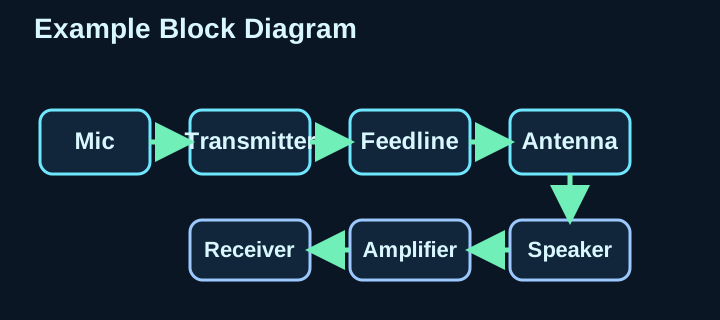
A block diagram shows major parts and signal flow in a simple high-level way.
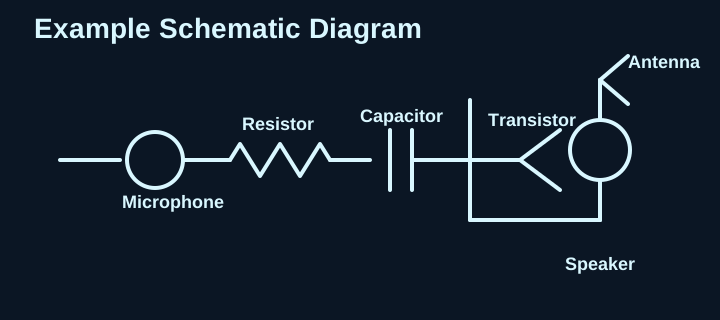
A schematic diagram shows detailed electrical connections and symbols for actual circuits.
A block diagram emphasizes major parts and signal flow without showing every electrical detail.A schematic diagram shows component-level electrical symbols and how the circuit is actually connected.
Block diagrams vs schematics locked
Sign in or create an account to mark progress complete.
Radio station block diagram
Draw the required block diagram and be ready to explain what each component does.
Include these parts
Microphone, speaker, transceiver, transmitter, receiver, amplifier, feedline, and antenna.
Show how audio or radio signals move from one part to the next.
Radio station block diagram locked
Sign in or create an account to mark progress complete.
Consumer radio devices and services
List several devices or services that use analog or digital radio communication.
Examples
Broadcast receivers, cell phones, Wi-Fi routers, Bluetooth earbuds, key fobs, garage door openers, baby monitors, GPS receivers, and walkie-talkies.
Consumer radio devices and services locked
Sign in or create an account to mark progress complete.
NOAA Weather Radio alerts
Explain why NOAA Weather Radio is useful for warnings and emergency information.
What NOAA means
NOAA stands for the National Oceanic and Atmospheric Administration.
NOAA is a U.S. government agency that studies weather, oceans, climate, and the atmosphere.
What NOAA Weather Radio does
NOAA Weather Radio, often called NWR, provides official weather forecasts, watches, warnings, and hazard information 24 hours a day.
It can warn people about dangerous weather such as tornadoes, severe thunderstorms, flash floods, hurricanes, winter storms, and other local hazards.
Alert-capable radios can sound an alarm automatically when urgent warnings are issued for your area, even if you were not already listening.
Why it matters
It works as a dedicated warning source instead of depending only on phone apps, television, or internet service.
It can be especially helpful during power outages, storms, or emergencies when other information sources are unavailable or delayed.
For scouts and families, it is a strong backup tool for campouts, hikes, and severe-weather planning.
NOAA Weather Radio alerts locked
Sign in or create an account to mark progress complete.
RFID in everyday life
Explain what RFID is and where people use it.
What RFID means
RFID stands for Radio Frequency Identification.
It is a way for a reader to identify or exchange information with a tag by using radio waves instead of direct wired contact.
How RFID works
An RFID system usually includes a tag, a reader, and software or a system that uses the information.
The tag stores identifying data, and the reader sends out radio energy and receives a response from the tag.
Some RFID tags are passive and get their power from the reader's signal, while others are active and have their own power source.
Everyday examples
Access badges, toll tags, store inventory tracking, library systems, pet identification chips, and contactless payment tools.
RFID can also be used for tracking packages, event wristbands, transit cards, and identifying equipment.
Why it is useful
RFID can identify objects quickly without plugging anything in or scanning each item one by one.
It helps with inventory, security, automation, and faster checkout or entry systems.
Its range and capability depend on the type of tag, reader power, and the environment around it.
RFID in everyday life locked
Sign in or create an account to mark progress complete.